


1960's
This page will explore the work of the Liverpool Irish Centre Building Fund Committee, the opening of the Liverpool Irish Centre at 127 Mount Pleasant, and the key events of the 1960s.
The Liverpool Irish Centre Building Fund Committee
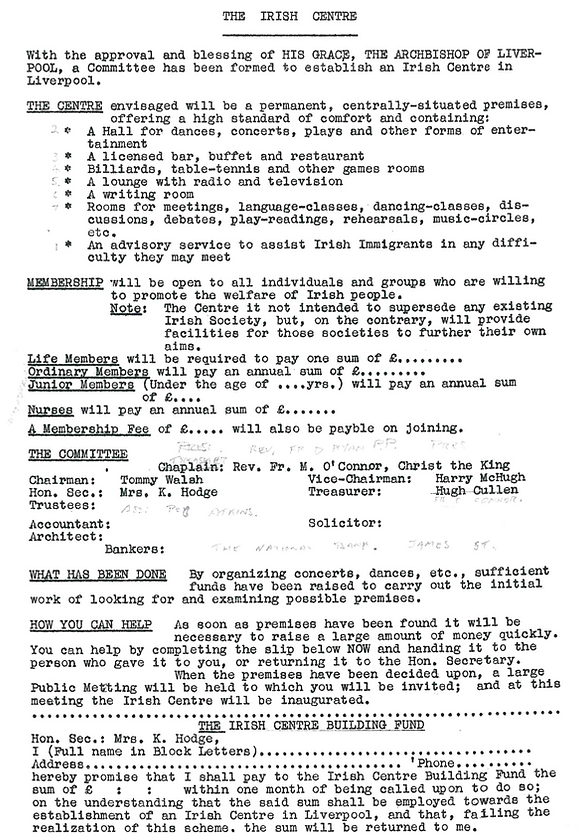
The Liverpool Irish Centre had been planned since 1961. To help establish a Centre dedicated for the Irish in Liverpool, the Irish Centre Committee and the Irish Centre Building Fund were created. The purpose of the Centre was to "create a premises which the Irish can call their own," with the building being a welfare and social centre.
This leaflet highlights the aims and organisation of the Irish Centre Building Fund Committee. The hand-written notes suggest that this was a draft version. Nevertheless, it is clear that the Committee had a clear aim which included: a hall for dances & concerts, a bar, a restaurant, a lounge, rooms for cultural activities and an advisory service to assist Irish immigrants in any difficulty.

In order to find and pay for a premises, the Irish Centre Building Fund Committee organised Irish concerts, dances and aid from His Lordship, Bishop Lucey to raise money. This is an example of just one of the many concerts organised by the Irish Centre Building Fund to raise money for an Irish Centre.
An Irish Centre At Last!
By 1964, the Irish Centre Building Fund had found a premises: the Wellington Assembly Rooms, 127 Mount Pleasant. They invited those interested to a public meeting and by the end of May 1964, the committee announced that they had acquired the premises.
‘Before we bought the building, we ‘borrowed’ it for a public meeting. Hundreds turned up. We said ‘There it is. If you want it- say so and we’ll make an offer.’ The response was tremendous. Promises were converted into cash, hundreds of membership fees were collected, but in financial terms the money still didn’t pay the fees, let alone the deposit. What mattered was the outpouring of emotion. The feeling that as a community of over a hundred years we were taking our rightful place in the city of Liverpool. Older people went openly and said they had believed it would never happen.’- Tommy Walsh, Being Irish in Liverpool, p. 97.


The Liverpool Irish Centre was officially opened by Eire Minister for External Affairs, Frank Aiken, at 127 Mount Pleasant on February 1st, 1965. The building, formerly known as the ‘Wellington Rooms’, were dubbed “the Mecca for Liverpool’s social and cultural life” by the Liverpool Echo & Evening Press. Aiken stated during the opening of the Centre he ‘hoped that trade between Ireland and Liverpool would expand’. The Lord Mayor also declared that, “some people spoke of Liverpool as being the capital of Ireland.”

At the formal opening of the Irish Centre, Liverpool

At the formal opening of the Irish Centre, Liverpool
The opening of the Irish Centre was covered in various newspapers which cannot be published here due to copyright. If you are interested in seeing these articles for personal/research purposes, copies of the original newspaper articles are available in the History Room at the current Irish Centre. Please drop in and visit!
The opening of the Irish Centre was commemorated every year by an Annual Dinner. Until 1979, these dinners took place around St Brigid's Day. Here are some photographs below of an Annual Dinner. It is unclear what year these photographs were taken.


The Aims of the Irish Centre
The following extracts are taken from a 'little book' that was produced in the early years of the Irish Centre. In the book, the aims of the Irish Centre are set out clearly:
1. To provide a place for Irish people to meet socially.
2. To assist manufacturers of Irish goods to display and sell their goods here in Liverpool.
3. To lift the image of the Irish in Liverpool as it has been presented to the people of Liverpool over the years.
4. Welfare: to help Irish people in distress.
There are hand-written notes which highlight that this was a draft version of the little book and in some cases, phrasing would have been changed for the final version. It is clear that the Irish Centre was to be a real home to the Irish in Merseyside and a place 'for the spiritual, cultural and temporal welfare of Irish people'. The book ends with an appreciation to all those who brought the Irish Centre into existence and who continued to support it.


Inside the Liverpool Irish Centre in the 1960s...

127 Mount Pleasant before the Metropolitan Cathedral of Christ the King was built


127 Mount Pleasant before the Metropolitan Cathedral of Christ the King was built
Key Events & Entertainment in 1960s
Liverpool Céilí Band


The Liverpool Céilí Band played a key role in the Irish Centre. The band was formed in 1958 and in 1963, they made history by becoming the first non-Irish band to win the All-Ireland Senior Céilí Band title at the Fleadh Cheoil in Mullingar. This victory was repeated the year after in 1964. The band provided music and entertainment throughout the years of the Irish Centre. You can here listen to some recordings of the Liverpool Céilí Band in the 1960s here and here. To find out more information about the Liverpool Céilí Band, you can buy a copy of Ray Rooney's The Spirit of the Reels: The Story of the Famous Liverpool Céilí Band in our shop!
1967 St Patrick's Week Festival

This is a leaflet for the St Patrick's Week Festival in 1967. For St Patrick's Night, there was a Céilí and Old Time Dance with music by the Liverpool Céilí Band. A celebrity concert took place on the Saturday and an Irish Centre Talent Competition on the Sunday.
This leaflet also highlights the various groups and activities across the Centre including the Irish Centre Players and the Irish Centre Choir.
The Irish Centre Players
The Irish Centre Players were a drama group set up in the early years of the Irish Centre. The name ‘Irish Centre Players’ was decided upon after the success of their first performance of ‘The Far-Off Hills’. Take a look at some of the programmes here:


The Liverpool Irish Centre Choir
The Liverpool Irish Centre Choir was formed in March 1967 by Joseph McNally. The press release to the right describes the importance of McNally and how it was 'at the request of the Irish Centre' that a choir was to be formed and trained. The choir took part in numerous events across the early years of the Irish Centre. It is a tradition that lives on today with the current Liverpool Irish Choir!

The Opening of the Liverpool Metropolitan Cathedral
The Liverpool Metropolitan Cathedral (officially known as the Metropolitan Cathedral of Christ the King) was completed and officially opened in 1967. It was a great opportunity for the Irish Centre which was located right in front of the Cathedral (see photographs below). It was said that you had to go through the Centre to get to the Cathedral! In May 1967, the Irish Centre was visited by Taoiseach Jack Lynch, his wife Mairin and the Irish Ambassador, Mr. Sean Molloy.
The visit is recorded in the Press release (below). Taoiseach Jack Lynch recalled that the Irish Centre was "a magnificent effort on the part of the Irish people in Liverpool" and a "home from home" for anyone who entered its doors.


Leon O'Kennedy's Exhibiton
During the winter of 1967, leading landscape artist and cousin to former U.S. President John F. Kennedy, Leon O'Kennedy, held his first ever exhibition in Liverpool, at the Irish Centre. For three weeks, paintings of the landscapes and mountains of Ireland were on display. Reportedly, Merseyside’s Irish community ‘flocked’ to see the exhibition, resulting in many of the paintings being bought. In total, Leon O’Kennedy presented 31 works of Irish country. One painting in particular was of the Kennedy family homestead in Wexford. Ultimately, O'Kennedy was reportedly delighted with the public interest shown in his exhibition.
.jpg)
Secretary Rosemary Spiby and Centre Manager Tommy Walsh at the O'Kennedy exhibition, Irish Centre, 1967.
'Adopt an Irishman for Christmas'
In December 1967, hundreds of Irish men and women were unable to return home, as boats and flights were cancelled for Christmas due to the 'foot in mouth' outbreak. The 'Adopt an Irishman for Christmas' scheme was operated by the Irish Centre, where local Liverpool families of Irish and other origins, invited those stranded to have Christmas Day or weekend with them. The scheme was very successful, so much so that the Irish Centre reportedly had nothing to do regarding hospitality on Christmas Day. In the 1968 Secretary's Report, it was noted that:
'Many of our members sacrificed their Christmas holiday at home in Ireland to assist in preventing the spread of foot-and-mouth disease which had devastated the British farming community. They are to be congratulated on demonstrating their love of Ireland in a very practical way.'
The report also reported on the success of Leon O'Kennedy's exhibition and that it had proven so popular 'it is anticipated that Mr. O'Kennedy will hold a similar exhibition early in the New Year. You can view newspaper articles about this story as well as the 1968 Secretary's Report in the History Room in the Liverpool Irish Centre.
Croc an Óir
The Croc An Óir shop officially opened on Wednesday 12th March, 1968, by Kevin Rush, Minister Plenipotentiary at the Irish Embassy. The press release stated that the shop will 'sell only Irish made goods of top quality.'

The Press Release for the opening of the Croc an Óir shop on 12th March 1968:

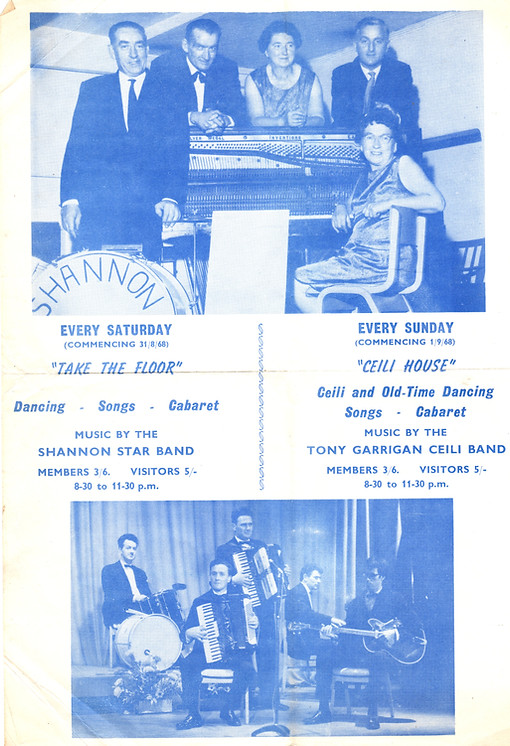
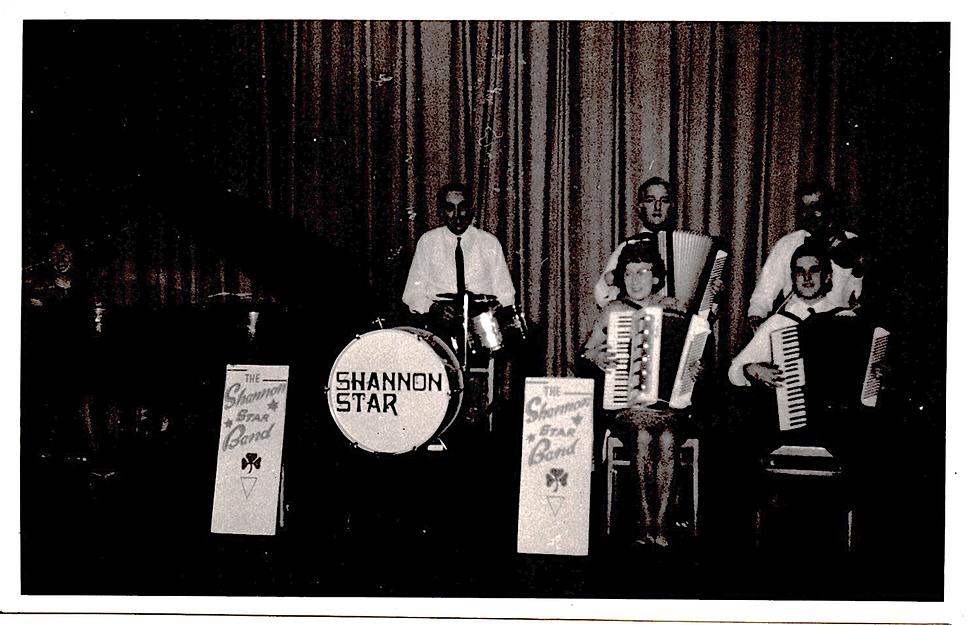
The Shannon Star Band
In 1968, the Shannon Star Band became the resident Saturday night band. You can see the original leaflet as well as photographs of the band taken by Eric Durkin, who played a key role in the Irish Centre.


An Irish Bargain?
A press release from June 1968 titled 'An Irish Bargain' outlines the beginning of a tradition that would live on in the current Liverpool Irish Centre: the importance of a raffle! Although Tommy Walsh outlined his usual 'abhorrence for raffles because they tend to cheapen the atmosphere of the evening', he recognised that it could be used to introduce members to Irish imports and a guaranteed sale of £10 each week.

October 1968: A Welfare Officer is appointed
From the 'little book' and the Irish Centre Building Fund Committee aims, it is clear that welfare was an important part of the Irish Centre. In 1968, an Irish Sister of Charity, Sister Jane Frances, was appointed as the Welfare Officer of the Irish Centre. She played a vital role in the early years of the Irish Centre.
1969: Irish Centre Bulletin
The bulletin from September 1969 gives us some great insight into what was happening in the Irish Centre as it prepared to enter the 1970s. The bulletin covers some attempts to start a Library, Irish language classes, dancing classes and a 'Keep-Fit Class'.
The impact of the events in Northern Ireland on the Irish Centre are clear in the notice that they are setting up a Six County Relief Fund to 'alleviate the distress of our countrymen in the Six Counties'. This was also outlined in the 1969 Secretary's Report which noted:
'One unhappy event which must be recorded was the unfortunate necessity for us to contribute to the alleviation of distress caused in the Six Counties by the terrible events of August, 1969. The Irish Centre donated £200 to Bishop Philbin in Belfast, £200 to the Derry Citizens Defence Association and forwarded many parcels containing clothing and bedding to Clonard Monastery, Belfast. A concert in aid of the Northern Ireland Distress Fund was arranged to take place here in October.'
The bulletin also emphasises the need to prepare for refugees from Belfast by compiling a Register of Available Emergency Accommodation, emphasising the welfare role of the Irish Centre.

